
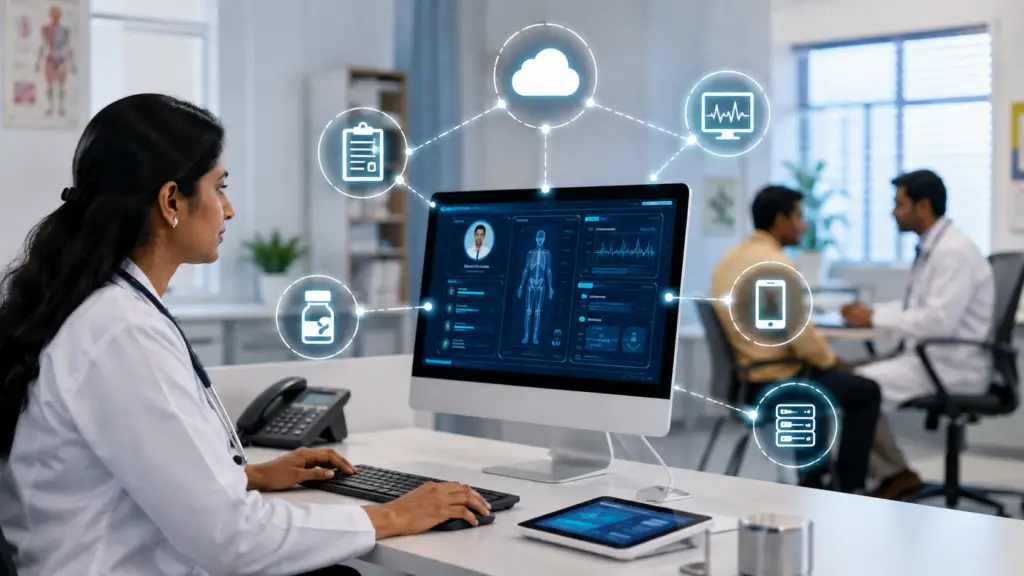
Modern clinics use digital tools for patient records, appointments, prescriptions, lab reports, billing, and communication. However, when these systems cannot share information with each other, healthcare teams may waste time entering the same data again.
This is where healthcare interoperability becomes important. It allows different healthcare systems and applications to exchange and use information in a more connected way.
🔄 What Is Healthcare Interoperability?
Healthcare interoperability means different digital healthcare systems can share, exchange, and understand information.
For example, a clinic management system may need to work with laboratory systems, digital health platforms, pharmacies, or other healthcare applications.
Instead of keeping information in separate digital “islands,” interoperability helps connect these systems.
👨⚕️ Helps Doctors Access Patient Information
Doctors often need information from different sources to understand a patient’s health history.
With better interoperability, authorized healthcare professionals can access relevant information more efficiently.
✅ Patient history
✅ Lab reports
✅ Prescriptions
✅ Previous consultations
✅ Diagnostic information
As a result, doctors can spend less time searching for records and more time focusing on patient care.
⏱️ Saves Time for Clinic Staff
Without interoperability, staff may need to enter the same patient information into multiple systems.
This can take valuable time and may also lead to errors.
Interoperable systems can help reduce repeated data entry.
✅ Less manual work
✅ Faster information sharing
✅ Fewer duplicate records
✅ Smoother clinic workflows
Therefore, interoperability can make everyday clinic operations more efficient.
🧾 Reduces Data Entry Errors
Manually copying information from one system to another can result in mistakes.
A wrong name, incorrect value, or missing medical detail can create confusion.
When systems exchange information properly, the need for repeated manual entry can be reduced.
This can help improve data accuracy and consistency across healthcare workflows.
🧪 Makes Lab and Diagnostic Reports Easier to Manage
Lab reports are an important part of many clinical decisions.
If diagnostic information can move securely between compatible systems, doctors can access relevant results without relying heavily on paper reports or manual transfers.
This can make the process faster and more organized.
🔐 Supports Secure Information Sharing
Interoperability is not simply about moving data from one system to another. Security and privacy are equally important.
Healthcare organizations should use appropriate authentication, access controls, encryption, audit trails, and consent mechanisms where applicable.
Therefore, clinics should choose systems that support secure and responsible information exchange.
📈 Helps Clinics Work More Efficiently
Interoperability can also improve clinic operations.
Connected systems can help clinics:
✅ Reduce duplicate work
✅ Improve patient flow
✅ Organize information
✅ Support better reporting
✅ Make workflows more efficient
Over time, these improvements can help clinics provide a smoother experience for both patients and staff.
🌐 Supports the Future of Digital Healthcare
Healthcare is becoming increasingly connected. Digital health records, teleconsultation, laboratory systems, pharmacies, and health information networks all need reliable ways to exchange information.
Standards such as HL7 FHIR are designed to support the exchange of healthcare information between different applications.
In India, initiatives such as the Ayushman Bharat Digital Mission (ABDM) are also focused on creating a more connected digital health ecosystem.
🏥 How OPDTab Can Support Modern Clinic Workflows
OPDTab provides digital tools for managing important clinic operations, including patients, appointments, doctors, prescriptions, lab reports, billing, and video consultations.
As healthcare becomes more connected, having organized digital data is an important foundation for building efficient and interoperable clinic workflows.
Final Thoughts
Healthcare interoperability can make digital healthcare more connected, efficient, and useful.
By allowing compatible systems to exchange information securely, clinics can reduce repetitive work, improve data accuracy, and help doctors access the information they need.
In short, interoperability is an important step toward smarter and more connected healthcare clinics. 🔄🏥
📞 Connect with OPDTab
📞 Phone: +91 8117019994
📧 Email: contact@opdtab.com
📍 Location: Bhubaneswar, Bangalore
🌐 Website: www.opdtab.com
